DuckDuck Go is one of the most popular search engines amongst privacy enthusiasts worldwide. However, it seems that DuckDuck Go has been banned in India by multiple ISPs. Several users running Airtel, Jio, and Vodafone took to Reddit and Twitter, saying they weren’t able to access the DuckDuck Go website on their smartphones as well as PCs.
This comes two days after the Indian government banned 59 Chinese apps in the country. However, DuckDuck Go is a US-based search engine company, and we believe there are no apparent reasons for the government to ban it. According to some users, visiting the official website of the privacy-focused search engine is displaying a “server not reachable” error message.
Users have been facing the issue since this morning. Many have said that DuckDuck Go is banned on mobile data and not on a broadband connection. After facing the issue, a couple of users successfully managed to access DuckDuck Go using a VPN. ‘DuckDuck Go’ has already begun to trend on Twitter. Meanwhile, the search engine company posted on its Twitter handle, stating that there’s nothing wrong on their end.
To our users in India: We’ve received many reports our search engine is unreachable by much of India right now and have confirmed it is not due to us. We're actively talking to Internet providers to get to the bottom of it ASAP. Thank you for your patience.
I was able to visit DuckDuck Go on using Vodafone mobile data but a friend of mine wasn’t able to access it on Airtel. Moreover, my colleague wasn’t able to surf through the DuckDuck Go app on his iPhone.
Amidst the uncertainty, the reason behind the issue is still unknown. This isn’t the first time an ISP has blocked a website in India. Earlier, Jio telecom blocked Telegram, porn websites, and even SoundCloud.
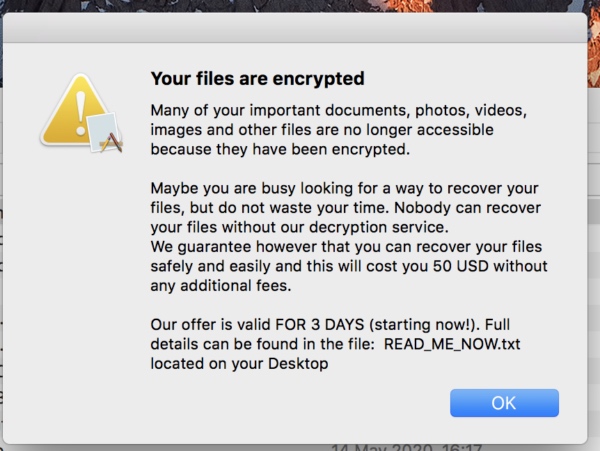
A new Mac ransomware has been discovered by folks at Malwarebytes. According to the report, it’s a variant of “EvilQuest” ransomware which is spreading through pirated Mac apps.
The team discovered the ransomware after Twitter user @beatsballert messaged them about a pirated Little Snitch app on a Russian forum, which distributes torrent links. Analyzing the installer, researchers at Malwarebytes discovered it’s not just malware but new ransomware.
Just by looking at installer, the team was skeptical since it had a generic installer package. Unexpectedly, the package did install the actual Little Snitch but side by side, it installed an executable file named “Patch” as well as a postinstall script. While it is common for installers to include postinstall scripts, here the script was bundled with malware.
After running the script, the patch quickly moved to a different location and renamed itself “CrashReporter” which is a known macOS process. From there, the patch injects itself into several other areas. The team noted that several apps started to malfunction; however, the ransomware primarily encrypts Keychain files and other data files. Later, it asks users to pay a $50 to unlock the files.
Of course, the $50 fee doesn’t remove the malware, but interestingly, there were no clear instructions on how to pay the ransom in the first place. According to the report, the malware sometimes installs a keylogger as well; however, its functionality is unknown. Malwarebytes detects the malware as “Ransom.OSX.EvilQuest” and infected files can be recovered with a previous backup.
We advise users to steer clear of pirated apps for Mac since they can carry similar ransomware or other malware.
Tata Nexon has gained huge respect among petrolheads ever since it received a five-star safety rating in the global NCAP test. However, Tata Motors has made it much more than the safest Indian car. Whether it be the performance, safety, ride quality, or comfort, Tata Motors has provided all the elements in Nexon.
Here’s a review of Tata Nexon from a user of a different SUV brand. A Mahindra TUV 300 owner recently tested his hands-on Tata Nexon and shared his experience while driving the car. The owner of Tata Nexon, who was in the co-driver seat, recorded the video and uploaded it on his YouTube channel.
Here in this review, the guy is driving the petrol variant of Tata Nexon (Automatic Transmission). In addition, the review is based in a hilly region, dealing with sharp turns, uphills, and downhills.
Pros
Suspension: According to the TUV300 owner, Tata Nexon has a superior quality suspension system that perfectly deals with all kinds of bumps, jerks, potholes, etc. He never felt any kind of discomfort due to the suspension. Furthermore, he was so overwhelmed that he gave ten out of ten for the suspension system of Nexon.
Performance And Ride Quality: One of the most common issues people face while accelerating on the inclined roads is power lag. Despite being the AMT variant, the driver never felt any kind of jerk or power lag while accelerating. According to Mahindra TUV 300 owner, Nexon performed smoothly while accelerating up the hills and there were no issues with the pick-up.
Additionally, the steering was pretty smooth and he in fact referred to it as “smooth as butter.” Tata Nexon also has a low steering radius that further helps during sharp turns. As per his experience, the Tata Nexon SUV provides a hassle-free driving experience.
Comfort and Convenience: According to the TUV 300 owner, the seats are very comfortable. Even after going through a long journey, one would not feel any kind of back pain. Nexon has ample space in the rear cabin that provides sufficient legroom and headspace.
Braking Performance: One of the factors that profoundly impressed the Mahindra TUV 300 user was the braking performance of Nexon. As per his experience, the brakes in Tata Nexon have a good bite, and they are very precise in terms of application.
Mileage: The owner of Tata Nexon informed everyone that one could achieve a mileage of around 18 km/l. However, in hilly areas or the city, you can get about 12 to 14 km/l with automatic transmission. Drivers can also churn out better fuel-efficiency with manual transmission.
Cons
Image: Power Racer
In the opinion of TUV 300 owner, there are mainly two issues with Tata Nexon:
The first is the thick A-pillar on the driver’s side that sometimes hinders the driver’s visibility on sharp turns. While this becomes a problem only on sharp turns like in the mountains, it’s still an issue that we hope Tata will deal with in its upcoming models.
The second issue that the TUV 300 owner pointed out is the music system. Although Tata provides Harman Kardon speakers, he feels this is one area where Tata can improve. However, this issue feels like nitpicking because one can get any type of speakers installed in their car.
Apart from these minor issues, the owner of Mahindra TUV300 was highly impressed by the performance and ride quality of Tata Nexon. In the end, he said that it’s the best value car in this segment and highly recommends Tata Nexon to everyone.
After the recent dispute between India and China at the border, a lot of people have decided to boycott Chinese products. This situation intensified when the Indian Government banned TikTok and 58 other Chinese apps. For some reason, PUBG Mobile escaped the list; however, a huge number of people want the government to ban the game as well because it is also a Chinese app.
Now, this brings us to Call of Duty Mobile, which is a big competitor of PUBG Mobile. Millions of gamers enjoy Call of Duty Mobile, but a lot of them are still unaware of the game’s origin. Is Call of Duty Mobile A Chinese App? Questions like these are still surfacing on the internet. Well, no worries, because we’re going to clear up your confusion.
Is Call of Duty Mobile A Chinese App?
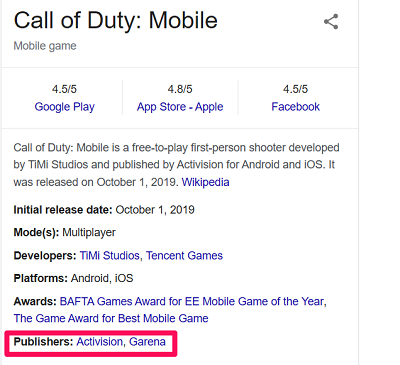
Call of Duty Mobile publisher
If you’re looking for a quick answer to this question, then NO, Call of Duty Mobile isn’t a Chinese app. The game is published by Activision and Garena, companies based in the USA and Singapore. It’s true that Call of Duty Mobile is developed by TiMi Studios, a subsidiary of the Chinese conglomerate, Tencent Holdings. However, most of the revenue goes to the game’s publisher, which isn’t Tencent in this case.
Origin Of Call Of Duty Mobile
In March 2019, Activision announced that TiMi Studios will be leading the development of the mobile version of Call of Duty Mobile. However, it was Activision who took care of the funding for the development of the entire game.
The game first had a soft launch in Canada and Australia on July 18. 2019. After the successful reviews from the soft launch, Activision finally released Call of Duty Mobile worldwide on October 1, 2019, and the game grabbed millions of players instantly.
Conclusion
Activision Blizzard Pvt. Ltd, an American Company, owns the entire Call of Duty franchise. So, Call of Duty Mobile also falls under Activision’s umbrella. The American tech company only hired TiMi Studios to lead the development of the game. In return, only a little portion of revenue share goes into the pocket of the Chinese game studio. The major chunk of money still goes to the publisher, which in this case, is Activision.
Today, the Chinese smartphone maker has launched the first MIUI 12 Stable update for Redmi Note 8 Pro. The update will come as an OTA update to Mi users who participated in the MIUI 12 Beta program.
This comes after Xiaomi recently released the final list of Mi users who have been selected for the MIUI 12 Pilot program. The beta program was available for owners of Redmi Note 8 Pro, Redmi Note 7 Pro, Redmi Note 7, Redmi Note 7S, and Poco F1.
Redmi Note 8 Pro MIUI 12.0.4 Global Stable
(Recovery ROM)
It is important to note that this is a MIUI 12 Stable Beta update. For those who don’t know, stable beta builds are essentially the final stable builds, they are first sent to beta testers for weeding out any bugs or software issues. After taking feedback from beta users, Xiaomi fixes the small errors, if there are any, and rolls out the same update for all the Xiaomi users.
Regular users can try installing the update through the manual update process, however, they will most likely come across an error. There is always an option to sideload the update via a custom recovery like TWRP, but that would require unlocking the bootloader.
Now that Xiaomi has begun rolling out MIUI 12 Global update to Redmi Note 8 Pro, we expect other devices that are part of the Pilot program will also get the update in the next few days.
Well, in the age of AI, developers are making AI capable of doing anything and everything. What about an AI that can cut-short all your hassles in getting a divorce? The Australian government has rolled out an AI named Amica that will help the partners in dividing money and property. Moreover, the AI will also help in making appropriate parenting arrangements without hiring a lawyer.
As reported in Gizmodo, Australian AG Christian Porter, mentioned that the Australian government is trying its best to improvise the Australian family law system. The main priority of the government is to make the system a bit more fast and cheap. He concluded his statement by saying that the government is also working on making the divorce process less stressful for the partners and their children.
As per the stats, most of the Australian couples were inclined towards dumping their partners owing to Coronavirus quarantine period. It is expected that just after a little relaxation from COVID-19, a large number of couples will appear in the court for separation cases.
So this was the best time according to the Australian government to launch Amica AI. It will not only make divorces simple but also reduce the upcoming pressure on the family courts. Australia’s family court system is already dealing with a lot of pending cases.
Amica AI Fee
As of now, Amica AI is completely free for all Australian couples. By 2021, a basic fee between $113 to $303 will be charged from the couples.
However, there is very little clarification about situations in which a partner refuses to agree with the arrangements. In that case, the couple will need a lawyer. Expectations are that Amica AI will work only for those who are on amicable terms and hence the name of the AI.
Freedom to choose, customize, create, and distribute is what Linux is known for. That is why we have more than 500 active Linux-based operating systems. In addition to the same, we’re going to have another new Linux distribution called Serpent OS, which is currently under heavy development.
Now, he is creating a truly modern Linux Distribution with notably different goals from the mainstream offering. To know what it means to say, you have to know what Serpent Linux is not going to be.
What Serpent Linux Isn’t
As Ikey says, if you’re looking for modern, lightweight, user-friendly, and privacy-focused Linux desktop distribution, then you’re in the wrong place. Serpent is not a ‘GNU/Linux’ distribution as it will be independent of the GNU toolchain or runtime.
Serpent dev team aims to build a Linux distribution for people who want to use Linux, not a “Linux-based-OS,” focusing on interoperability with macOS-plus-Windows. In simple words, Serpent Linux is not an operating system for everyone.
Rather, it’s an advanced Linux distribution that will be both modular and optimized for modern machines. Hence, you should consider it if you want to use Linux distribution as Linux.
Serpent OS: Linux Distro For Modern Machines
I guess you now have enough idea what Serpent Linux is going to be. It definitely won’t be for beginners and people who want to run it on their older hardware.
On top of that, Ikey also says that Serpent might not ship proprietary driver support that holds back the development of Linux. For instance, NVIDIA and their lack of support for accelerated Wayland support on their GPUs. Therefore, they might blacklist the NVIDIA proprietary drivers from the Serpent distribution.
Though a clear picture of what Serpent will include and what not is not out yet. But here are some features revealed so far.
Systemd init system
No more usrbin split
100% clang-built throughout (including kernel)
musl as libc, relying on compiler optimizations instead of inline asm
libc++ instead of libstdc++
LLVM’s binutils variants (lld, as, etc.)
Mixed source/binary distribution
Moving away from x86_64-generic baseline to newer CPUs, including Intel and AMD specific optimizations
Capability based subscriptions in package manager (Hardware/ user choice / etc)
UEFI only. No more legacy boot.
Completely open-source, down to the bootstrap / rebuild scripts
Seriously optimised for serious workloads.
Third party applications reliant on containers only. No compat-hacks
Wayland-only
Fully stateless with management tools and upstreaming of patches
Speaking of release dates, the project is currently in a stage1 bootstrap phase, with stage2 ready. The process of establishing the project is underway and development will properly start by the end of July 2020.
What do you think of the upcoming Serpent Linux? Do we really need a new Linux distribution? Do share and comment.